Introduction to Dynasty Basketball Trade Calculator
A dynasty basketball trade calculator is a resource that assists fantasy basketball managers in assessing trades within long-term leagues. It allocates values to players according to their age, performance, injury record, and future potential. When you engage in a trade, it immediately evaluates both sides and reveals who is receiving the more favorable offer — eliminating any uncertainty from your choice. dynasty trade calculator
🏀 Basketball Trade Calculator
Live Player Values · Past (24-25) · Current (25-26) · Next (26-27)
📤 SIDE A (You give)
0.0📥 SIDE B (You receive)
0.0Why is it important in fantasy basketball
In dynasty leagues, a single poor trade can damage your team for years. But this calculator safeguards you by:
- Demonstrating the lasting effects of each trade prior to your acceptance.
- Adjusting player valuations instantly according to injuries and performance.
- Lacking this tool, you run the risk of conceding too much — or agreeing to too little — in every negotiation.
How it helps you win more trades
Understand actual player worth — Identify precisely who is overpriced or underpriced in any transaction.
- Instantly compare trades — Obtain a complete value analysis in seconds instead of hours.
- Save time — Eliminate the need for hours of manual research prior to each trade.
- Negotiate assertively — Utilize actual data to advocate for improved agreements.
How to Read Trade Calculator Results
- Understanding value difference
- What “fair trade” really means
- When to accept or reject a trade
Key differences explained
In a dynasty league, you retain your players from one year to the next. Each trade, draft selection, and roster choice carries implications that endure for several seasons, resulting in dynasty being much more strategic and fulfilling. The primary distinction lies in dedication. Rewriting incentives promotes immediate planning. Work like fantasycalc
Long-term vs short-term strategy
In a dynasty, the approach changes entirely:
- Young players are valuable — even if they haven’t shown results yet.
- Aging stars decline quickly — their peak years are over.
- Draft selections are regarded as assets — future first-round picks can hold the same value as seasoned players.
- Rebuilding is a genuine approach—trading veterans for youngsters and draft picks is a wise long-term strategy.
- Prospects are important — a player who isn’t in the league yet can still hold significant value for your roster.
- Focusing on short-term results in a dynasty league is one of the quickest paths to lagging behind. The managers who build dynasties consistently plan two or three seasons in advance.
Advanced Strategies for Dynasty Basketball Trades
- Rebuilding vs contending strategies Stacking young talent Flipping players for value Timing the market
- Stacking young talent Flipping players for value Timing the market
- Timing the market
Why player age matters more in dynasty
Age is the most crucial element in dynasty fantasy basketball — more than present statistics, more than team circumstances, more than any other factor. Here’s the reason:
Young athletes increase in worth. Having that player during their peak years is where dynasty titles are created. Veteran players deteriorate quickly. A 32-year-old player might still be performing strongly at the moment — however, in two to three seasons, their worth will decline significantly. Exchanging them at their highest worth before the drop occurs is a crucial skill for dynasties.
You possess players for the long term. In redraft leagues, age is less significant since you require a player for just one season. In dynasty leagues, you can possess that same player for five, six, or seven years — indicating their age progression directly influences your team’s prospects.
Trade value is directly influenced by age. A 22-year-old and a 33-year-old with the same statistics now have vastly different values in a dynasty league. The calculator consistently considers age to ensure you never pay too much for a player nearing the end of their career.
How Trade Calculators Analyze Deals
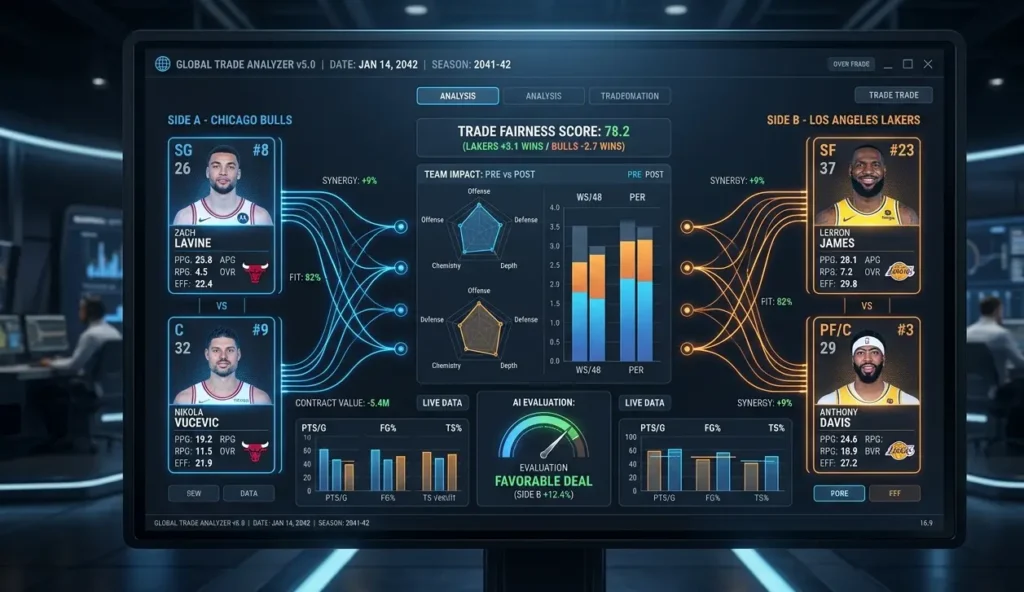
Statistical weights are (points, rebounds, assists, etc.)
Not all statistics hold the same significance. The calculator evaluates players according to the influence each statistic has on fantasy value in your league setup. Points and assists generally hold the most significance, with rebounds, steals, blocks, and shooting efficiency following closely behind.
Athletes who excel in various categories achieve. Not all statistics hold the same significance. The calculator evaluates players according to the influence each statistic has on fantasy value in your league setup. Points and assists generally hold the most significance, with rebounds, steals, blocks, and shooting efficiency following closely behind.
Athletes who excel in various categories achieve better scores than those who only perform in a single area — encouraging genuine fantasy flexibility.
Role of advanced metrics
These metrics assist the calculator in pinpointing players who are overlooked by conventional statistics — and highlight those who appear more impressive in theory than they truly are.
Common Trade Myths in Fantasy Basketball
- “Big names always win trades”
- “Young players are always better”
- “More players = better deal”
Types of Dynasty Basketball Leagues Supported
Points leagues
In a points league, every statistical action earns a set number of fantasy points. Points, rebounds, assists, steals, and blocks each have a fixed value assigned by your league settings. The dynasty trade calculator adjusts player values based on your specific points system — so a player who scores heavily but contributes little elsewhere is valued correctly for your format, not a generic standard.
Trade comparison logic
Upon entering a trade, the calculator sums the total value score for both sides and compares them immediately. It demonstrates the value difference between the two teams—allowing you to see who excels in the trade, by what margin, and what changes would render the agreement equitable. This straightforward reasoning transforms intricate trade choices into clear and assured responses consistently.
Roto leagues
The dynasty trade calculator assesses players who perform consistently in all categories throughout an entire season—favoring dependability and discouraging players who are streaky or prone to injuries, as their inconsistency can negatively impact your overall rankings for the season.
Keeper formats
Keeper leagues fall between redraft and complete dynasty formats, as managers hold onto a select number of players each year instead of maintaining full rosters.
What to Include in a Trade Evaluation
Players involved
The basis of any trade assessment begins with the players involved in the exchange. The calculator evaluates each player involved in the trade, considering age, present performance, injury records, positional rarity, and future forecasts.
Draft picks and future assets
Draft picks are valuable currency in dynasty basketball. A future first-round pick can be worth as much as an established roster player, depending on the team it comes from. The calculator assigns realistic values to all draft picks based on projected lottery odds, team strength, and pick position.
League scoring settings
Each dynasty league varies. A player who excels in a 9-category league may hold significantly less worth in a points-only scoring system. The calculator modifies each player’s value according to your league size, scoring format, and personalized settings.
This ensures the trade analysis is precise for your specific league — rather than a generic estimate that fails to represent how your league values performance.
Team needs and strategy
The raw player value represents merely a portion of the overall scenario. The current position of your team is equally important. A team in the process of rebuilding ought to focus on young athletes and draft choices instead of older players who are geared for immediate success.
A competitive team might have to trade future assets for established performers now. The calculator assists you in aligning each trade with your present strategy — ensuring every action advances your dynasty correctly, whether you’re reconstructing or pursuing a championship.
When NOT to Trust a Trade Calculator
- Unique league rules
- Personal team strategy differences
- Playoff timing decisions
Step-by-Step Trade Analysis Using the Calculator
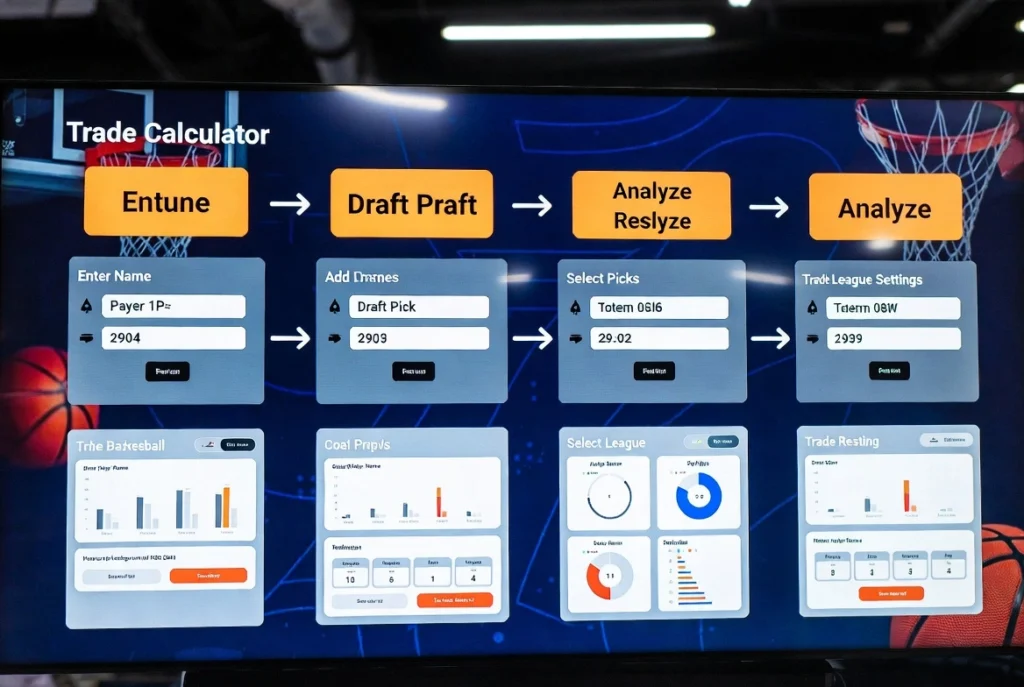
Input trade details
Begin by listing all players and draft selections being traded by each party involved. Utilize the search feature to swiftly locate each player by their name and assign them to the appropriate team.
Customize league format
After entering your trade, adjust your league format to align with your actual league settings. A player highly valued in a 12-team points league might have a significantly different worth in a 15-team category league
Review trade value score
Upon inputting all information, the calculator promptly produces a value score for both sides of the transaction. The overall value for Team A and Team B is displayed next to each other, including the difference between them.
A minor discrepancy indicates that the trade is approximately equitable. A significant difference clearly indicates which team is leading the deal and by what margin, providing you with all the information required before deciding.
Interpret results correctly
The value score serves as a strong indicator — but it is most effective when paired with your personal league insights. A small advantage in value doesn’t necessarily imply you should decline a trade.
Think about your team’s requirements, your rebuilding or immediate winning approach, and the particular players in question. Utilize the calculator as your base and apply your own reasoning beyond that. When the gap in value is significant, rely on the data. When it approaches, allow your strategy to determine.
Enhancing Your Trades Beyond the Calculator
Using data vs emotions
Each fantasy manager has experienced the desire to acquire a beloved player or turn down an offer in frustration. Emotions are the primary adversary of intelligent decision-making in dynasties. The trade calculator substitutes emotions with data — providing you with a precise, unbiased value score for each transaction.
Trading based on data rather than emotions allows you to make steady, assured choices that strengthen your dynasty roster as time goes on.
Monitoring player trends
Player values in ppr dynasty trade calculator are always in flux. A standout display, a significant injury, a team exchange, or a modification in playing minutes can alter a player’s worth drastically in a single night. Astute dynasty managers consistently keep an eye on these trends and utilize the calculator to make quick decisions — acquiring players whose value has briefly declined and trading away players whose value has surged before the rest of the league notices.
Identifying undervalued players
The most significant wins in dynasty basketball trades are often not the most glamorous — they are those where you secured a future star before others saw his worth. term forecasts that surpass.
Frequently Asked Questions
Posts
- - Dynasty Trade Calculator (March 30, 2026)
Pages
- Disclaimer - Dynasty Trade Calculator (April 15, 2026)
- Terms And Condition - Dynasty Trade Calculator (April 15, 2026)
- About Us - Dynasty Trade Calculator (April 15, 2026)
- Contact Us - Dynasty Trade Calculator (April 15, 2026)
- Privacy Policy - Dynasty Trade Calculator (April 15, 2026)
- Legal Pages - Dynasty Trade Calculator (April 9, 2026)
- 10 Dynasty Trade Calculator Tips to Win Fantasy Football Trades (2026) (April 9, 2026)
- Dynasty Hockey Trade Calculator(2026) – Analyze & Win Every Trade (April 6, 2026)
- Best Dynasty Basketball Trade Calculator Online (2026) (April 6, 2026)
- Baseball Dynasty Trade Calculator (2026) – Analyze & Win Fantasy Trades (April 4, 2026)
- Dynasty Trade Calculator – Analyze Trades Fast (March 29, 2026)