Free Dynasty Trade Calculator for Fantasy Football
Stop guessing on dynasty trades. Use real player values, draft pick data, and position-based rankings to find out who is actually winning any deal before you hit accept.
Introduction
Dynasty leagues are unforgiving. One bad trade in year one can wreck your roster for the next three seasons, and by the time you figure out what went wrong, everyone else has already lapped you. That is the reality, and it is exactly why serious managers do not wing it anymore.
Most managers who use a trade calculator say the same thing: They wish they had started sooner. Not due to losing every trade, but rather because they lacked a dependable method to verify if a deal was genuinely fair.
You would agree to a deal that seemed right, see the player you exchanged thrive six months later, and then spend the entire season questioning where it all went wrong.
Your football knowledge stays yours. The numbers simply back up what you already know, so you are never walking into a trade conversation completely blind. Basketball trade calculator
What Is a Dynasty Trade Calculator?
Simply put, it is a tool that gives a number to each player and pick in your league, then analyzes both sides of a trade so you can determine who benefits more from the transaction. You input the assets, it calculates, and you leave with a clear understanding of your position.
No spreadsheets, no assumptions, no being persuaded into something that doesn’t make sense.
Dynasty and redraft leagues are not really the same game; the time horizon is completely different. In redraft, you are only thinking about this season. In a dynasty, a 23-year-old receiver you pick up today might anchor your roster for the next seven years.
Or he might flame out in two. Age, opportunity, and team situation all feed into the score, giving you a realistic picture of each player’s long-term value, not just their numbers right now.
Before tools like this existed, most managers relied on gut instinct and whatever the most vocal person in the group chat was saying. It’s perfectly fine if you’re simply playing for fun. Yet, if you genuinely aspire to compete and build something lasting, you need a base that goes beyond mere feelings.
How It Works — And What It Is Actually Measuring
Every player in the system has a trade value score. Every aspect of that number is intentional; factors like age, recent performance, positional rarity, injury record, and expected opportunity all contribute to it. Younger athletes achieve higher scores due to having more prime years to come.
Dynasty rewards patience, and the tool is built around that reality. Enter a trade, and both sides get totaled up side by side. The tool then shows you which side is ahead and by exactly how much, broken down by player. That breakdown is how you figure out what to push for in a counteroffer.
Draft selections operate in the same manner. A first-round selection from a rebuilding team that has come in last for three consecutive years holds significantly greater value than a first-round selection from a contender choosing 12th overall.
Age—The Factor Most Managers Underestimate
Here is something that trips up even experienced dynasty managers. Two wide receivers, same stats this season, but one is 24, and one is 31. In redraft? They are fairly close in value. In a dynasty? Those two players are miles apart.
A 24-year-old still has at least eight or nine fruitful seasons ahead. A 31-year-old may have two or three years remaining, possibly even fewer, based on the role. Running backs decline at a quicker rate.
A 28-year-old running back, instrumental for four seasons, has already surpassed his peak trade value, no matter how remarkable his recent statistics may seem.
All of that gets priced in automatically. You do not have to manually discount older players or reward younger ones—it is already done. Avoiding that one mistake alone can save you a full rebuilding cycle in some leagues.
Stats and Opportunity — What Is Actually Driving the Value
Raw statistics are important, but they provide only a portion of the narrative. A receiver making 80 catches on a struggling team without a running game is achieving those statistics out of necessity. Shift him to a more balanced attack, and he could receive 55 targets rather than 110.
Context matters as much as the box score, and that gets factored into how each player is valued.
Opportunity is the real driver for targets for receivers, carries for backs, and snap percentage across the board. A player with elite opportunity and average stats is often worth more in dynasty than a player with flashy numbers and limited volume.
Young players still developing are the clearest example that usage trends tell you more about their future than anything in their current stat line.
Injury history matters too. Some players simply get hurt more often than others. Injury-prone players are not blacklisted from the system; they simply receive a realistic discount that accounts for availability risk.
Overpaying for a talented but fragile player is one of the most painful ways to lose value in dynasty, and it happens constantly when people rely on name recognition alone.
Why You Should Actually Be Using This Tool
It is not magic. What it does well is remove emotion from the equation exactly when you need it most: when someone is pitching you a trade, and you are already excited about the player coming back.
Most bad dynasty trades happen in that window. Someone offers you a recognizable name, you see the upside, and you say yes without checking the numbers. Two years later, that player is a backup, and you gave away a cornerstone piece to get him.
A 60-second check tells you whether what you are feeling actually lines up with what the data says. Finding undervalued players worth targeting is another area where this tool earns its keep. A rough few weeks can push a player’s market value down significantly.
You can see exactly how much it has moved and decide whether that creates a buying window. The majority of managers merely respond to what is immediately before them. Embracing a proactive strategy instead of a reactive one offers a real competitive edge.
Key Features Worth Knowing About
Values update regularly based on what is actually happening during the season, injuries, depth chart changes, and breakout performances. You are not working with numbers from week one of last year. Stale data will steer you wrong in dynasty.
Value moves fast, and the tool keeps pace with the current landscape. Every major format is covered: PPR, Half-PPR, Standard, and Superflex. Switch between them and watch the values adjust accordingly.
Superflex is where it really earns its place, because quarterback value in those leagues is completely different from standard formats. Many managers undervalue quarterbacks in Superflex leagues and get taken advantage of as a result.
Rookie pick evaluation is fully built in. You can compare a 2026 first-round pick against a veteran receiver and get a clear answer on which side holds more value. Early picks from weak teams and late picks from playoff contenders are priced differently because the expected slot value is completely different.
If someone has ever tried to trade you a first-round pick without mentioning that it comes from the best team in the league, you already know exactly why this matters.
Understanding Why Dynasty Trade Values Move
Trade values are not fixed. They shift week to week, sometimes dramatically. A player installed as the clear number-one option under a new coordinator can double in trade value within a month. A player who tears his ACL in week three goes from valuable to nearly untradeable overnight.
Many managers get burned right here. They remember what a player was worth three months ago and keep pricing trades off that old number. This tool always reflects current value, not last month’s figures, not preseason rankings, so every negotiation starts from an honest and accurate baseline.
There is also a future value dimension to consider. Some players are worth a great deal today but are clearly on a downward trajectory. Others look underwhelming now but are sitting in a situation that is about to improve significantly. Strong dynasty managers think about both.
Putting an actual number on that difference is far more reliable than acting on instinct alone.
Buy Low, Sell High – And How to Actually Execute It
This strategy sounds obvious, but most people execute it in reverse. A player struggles, and managers panic and trade him away. A player goes off for three straight weeks, and suddenly everyone is holding forever. Both instincts cost you in dynasty.
More often than not, the smarter play runs counter to your first instinct. A talented player going through a rough month is your window to acquire him before the rest of the league catches on. After a career game, when excitement is at its peak and trade offers start rolling in, that is your window to sell.
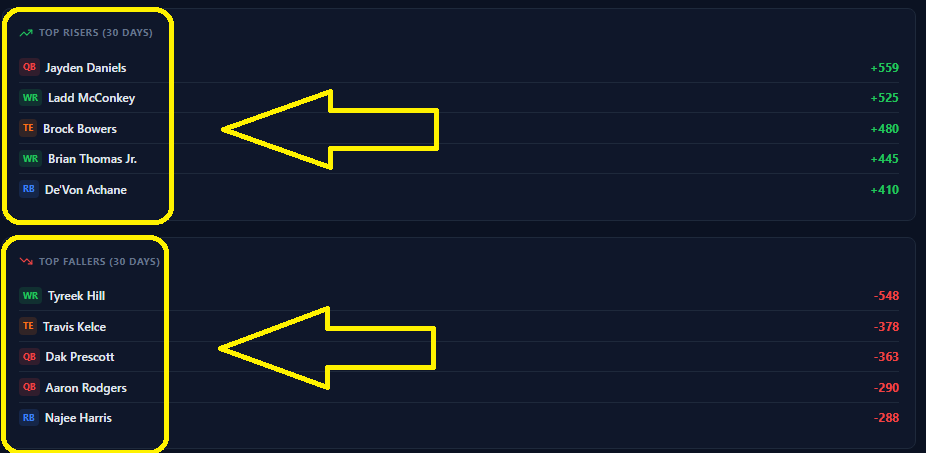
Seeing exactly where a player’s value sits right now versus two weeks ago makes the buy-low move far easier to execute with confidence. You are not guessing whether someone is undervalued; you can see it clearly.
And you are not just hoping your instinct is right when you push a trade through. You have data supporting every move.
Rebuilding vs. Competing: Different Goals, Different Trades
If your team is not competitive right now and you recognize this, the poorest choice is to keep bringing in seasoned veterans to try to align with a nonexistent opportunity.
You eventually exchange promising young players and draft selections for individuals who have passed their prime, and years later, you’re still in the rebuilding process, but now you don’t have the necessary assets to succeed. Reconstruction means being honest with oneself.
Package those aging veterans while they still carry market value, load up on early picks, and be genuinely patient. It may not be thrilling, but it’s the method for creating a team that secures several championships instead of merely achieving a single stroke of luck.
Conversely, if you possess a genuine competitive opportunity, a robust young core reaching its prime, and a solid supporting cast, do not hesitate to exchange picks for established contributors who can elevate your success immediately. Calculate the figures initially and ensure the math truly backs the decision before proceeding.
When to Trade Draft Picks – and When to Hold
Early picks, especially first-rounders from struggling teams, are among the most valuable assets in dynasty. Treat them accordingly. Do not throw them into trades as sweeteners unless you are getting back something that meaningfully moves the needle on your roster.
Later picks are more flexible. A second or third-rounder can be a useful piece to add to a deal without sacrificing significant long-term upside. Those picks are also easier to replace through normal league activity waivers, small trades, and divisional wins.
Handing over multiple first-round picks for a player who is already 29 happens more than you would think, and it rarely ends well. You are mortgaging your future for someone with two or three years left at best.
Execute that scenario in the tool and observe how imbalanced it seems. It is enlightening when the figures are presented before you. It is revealing when the figures are presented before you.
Common Mistakes Dynasty Managers Keep Making
Overvaluing big names is probably the most widespread problem. A well-known player’s name comes across in a trade offer, and your brain wants to say yes before you have even read the full terms. That is name recognition working against you.
Famous players who are past their peak still carry cultural weight, but their actual trade value tells a very different story.
Ignoring pick value is a close second. Many managers treat picks as an afterthought, something you throw in to close a deal. In reality, a first-round pick from a tanking team can be worth more than a solid starter at certain positions. Always price it. Never wave it away.
Trading based on roster need rather than fair value is another common trap. You are desperate at receiver, so you overpay at receiver. That is understandable, but it is also how you weaken your roster in ways that take years to recover from.
The tool shows you what fair actually looks like in clear, objective terms. Whether you stick to that number is your call, but at least you will know exactly what you are giving up.
Skipping the calculator entirely is, honestly, the biggest mistake. It is free, it takes less than two minutes, and it is right here. There is no good reason not to check it before agreeing to any dynasty trade.
How to Use It – Step by Step
Step 1:
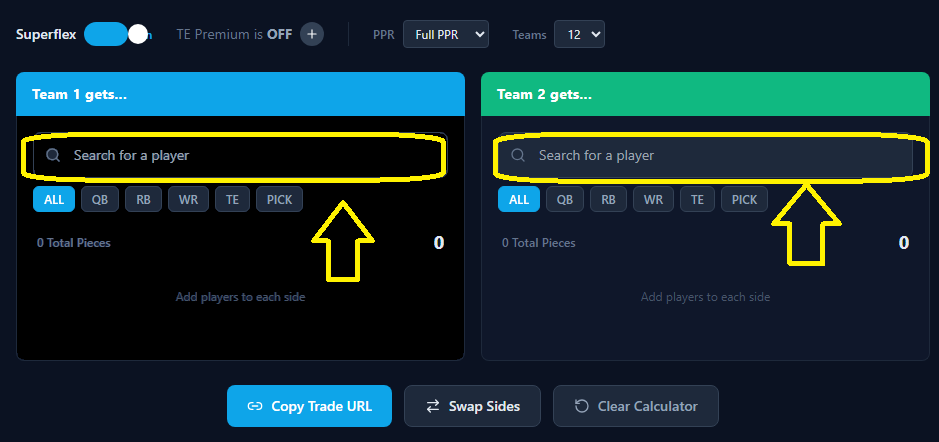
Enter every player and pick from both sides of the trade. Do not omit anything; even a minor addition can greatly alter the comparison.
Step 2:
Select your league format: PPR, Half-PPR, Standard, or Superflex. Format choice changes everything, especially quarterback values, so select the correct one before looking at any numbers.

Step 3:
Check the individual player values before looking at the totals. You want to understand where value is concentrated on each side, not just whether the overall totals are close.
Step 4:
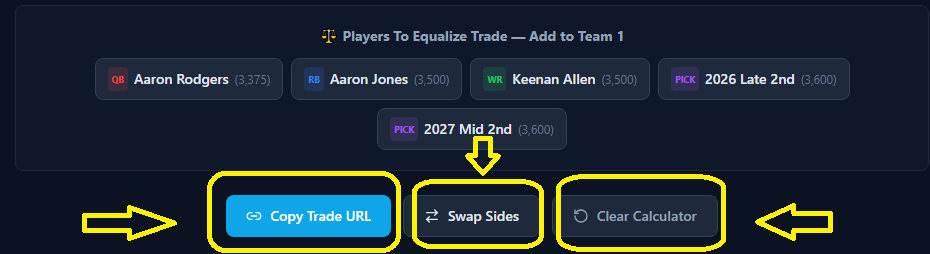
Read the comparison. Who is winning the deal, and by exactly how much, is right there on the screen? If you are on the short end, that is your starting point for a counteroffer.

Step 5:
Try different combinations. Swap one player out, add a pick, or ask for something back, and watch how the totals shift. That is how you find the version of the deal that actually makes sense for your roster.
Best Dynasty Football Trade Calculator Tools
Pros
- It delivers fast, consistent, and unbiased valuations across every player and pick in your league.
- It removes personal bias at the exact moment you are most likely to be biased.
- It works across all major scoring formats, updates with current performance data, and is completely free with no account required.
Cons
- Values are data-based estimates; they will not always match what your specific league thinks a particular player is worth.
- Local trends, home guidelines, and personal preferences of league members all influence real-world trade value in ways that no tool can entirely foresee.
- Utilize it as your base, then add your understanding of the individuals you are trading with.