🏒 Fantasy Hockey Trade Master 1v1 TRADE ANALYZER 🌍 GLOBAL EDITION
✅ 1 player per side | Professional white background | Real-time value graphs
📤 YOU GIVE (Trade Away)
📥 YOU GET (Trade For)
Introduction to Dynasty Hockey Trade Calculator
What is a Dynasty SF Trade Calculator?
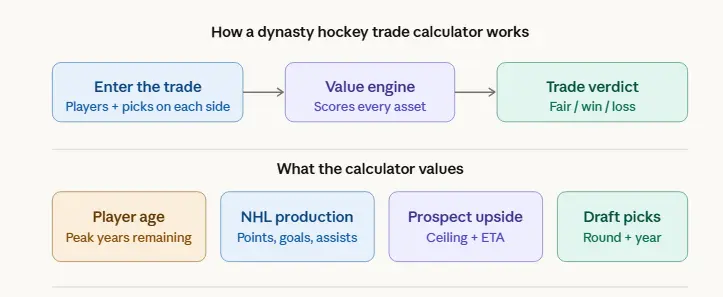
A dynasty hockey trade calculator is a dedicated resource designed for dynasty fantasy hockey leagues — setups where you keep players on your team from year to year instead of redrafting all members annually.
It allocates a numerical trade worth for each player, prospect, and draft choice in your league, considering various elements such as age, present NHL performance, position value, contract duration, growth potential, and ultimate ceiling.
When contemplating a trade, you input the assets for both sides — players leaving and arriving — and the calculator sums the value of each group.
The outcome indicates if the agreement is fair, if you’re conceding too much, or if you’re receiving the more advantageous part of the transaction. In contrast to typical redraft tools that primarily emphasize current-season stats, dynasty calculators place significant importance on future prospects.
A 21-year-old possessing decent present stats but exceptional potential might hold greater dynasty worth than a 32-year-old who has recently secured a scoring title. The calculator performs the calculations on that difference so you won’t need to estimate.
The most widely used calculators — such as Keep Trade Cut (KTC) — are driven by the community, indicating that the values are constantly refreshed according to how numerous actual dynasty managers are trading players in real-time leagues. This transforms them into a dynamic marketplace instead of an unchanging spreadsheet.
Why it is important in fantasy hockey leagues
Dynasty leagues differ fundamentally from redraft leagues. Since rosters are maintained from year to year, every trade impacts the future for many years to come.
A 35-year-old top scorer and a 22-year-old promising prospect may generate comparable statistics now, yet their dynasty values differ significantly. In the absence of a systematic approach for comparison, it’s simple to “succeed” in a trade shortly while secretly undermining your team’s future — or the opposite.
Dynasty leagues are inherently more intricate than redraft leagues, and this intricacy renders a trade calculator not just beneficial — but vital. Trades result in long-term impacts. In a redraft league, a poor trade can set you back for an entire season.
In a dynasty, an unbalanced trade can delay your franchise’s progress by three to five years. Trading a 20-year-old first-round talent for a 34-year-old top scorer can lead to success in the immediate seasons, but it completely depletes your rebuilding opportunities.
Without a calculator, it’s very challenging to perceive that cost clearly at that moment. A player’s worth peaks in his mid-to-late twenties a nd swiftly drops after 32.
Two players with identical current point totals can possess significantly different dynasty values if one is 24 years old while the other is 33 years old. A trade calculator automatically integrates those age curves, removing the necessity for you to individually assess each player’s expected decline. Dynasty baseball trade calculator
How it helps you make smarter trade decisions
A dynasty trade calculator doesn’t merely indicate if a trade is equitable — it transforms your perspective on constructing a roster completely. This is how it leads to improved choices at every phase:
Avoids Expensive Overpayments: The primary advantage is safety. Prior to completing any trade, a quick calculation confirms whether the values match.
If you provide 1,200 points of value and get 900, you understand that you should either request more or leave. This one use case alone can protect your dynasty franchise from years of harm.
That’s an opportunity to purchase at a lower price. On the other hand, when a player is experiencing a peak performance period, his perceived worth increases dramatically. This is your peak selling opportunity
How a dynasty daddy trade calculator Works
Player valuation system explained
At the heart of every dynasty rookie draft trade calculator is a player valuation mechanism — a scoring structure that translates a player’s overall dynasty value into one comparable figure, usually ranging from 0 to 10,000. This figure indicates not only a player’s current performance but also what he is expected to contribute throughout the rest of his career in your league.
Factors Used:
Every input factor contributes uniquely to the overall score. Grasping their interactions distinguishes skilled dynasty managers from casual ones.
Age
Age is the most significant determinant in assessing a dynasty’s worth. Since your roster extends from year to year, the count of remaining productive seasons for a player is more significant than his output in just one year.
Calculators use an age curve — a mathematical representation of the typical development and decline of NHL players over time. Players between 18 and 22 are in progress; 23 to 27 represents the main prime period; 27 to 30 is the typical peak; 30 to 33 marks early decline; 33 and older indicate significant decline.
A 24-year-old who scores 60 points holds significantly more dynasty value than a 35-year-old scoring 70 points, as the younger player potentially has 8–10 productive years remaining compared to the veteran’s possible 2–3
Performance
Performance (current NHL output) acts as the foundational indicator that a player has reached a point of proving he can succeed at the NHL tier. Points per game, involvement in power plays, time on ice, and contributions across categories (goals versus assists versus special teams) all contribute to the production score.
Nonetheless, raw production is consistently assessed based on age — strong production from a younger player enhances his worth more than equivalent production from an older player.
Potential
Possibilities account for advantages that existing output may not currently show. This is particularly important for prospects and younger athletes who have not yet attained their statistical peak. Calculators project potential based on draft history, player rankings, growth potential, position on their NHL team, and comparisons with peers.
A 20-year-old with potential for a top-six role, currently playing on the third line, may have far greater dynasty value than his existing point total indicates.
Injuries
Injuries impose a risk reduction on the final score. The nature, frequency, and seriousness of a player’s injury history all influence his worth. A player who has been sidelined for over 40 games in each of the last two seasons due to a significant injury will possess a lower dynasty score compared to a similarly skilled, healthy counterpart.
Injuries to the upper body, concussions, and surgeries impacting skating mechanics are discounted more significantly than soft-tissue injuries that have straightforward recovery records.
Result
Output of fairness verdict. Once all modifications are made, the algorithm yields a conclusive judgment: the percentage difference between the two parties, an easy-to-understand rating (Fair / Slight Edge / Clear Win / Lopsided), and the suggested “sweetener” — which extra asset would balance the trade.
Key Features of a Good dynasty league trade calculator with draft picks
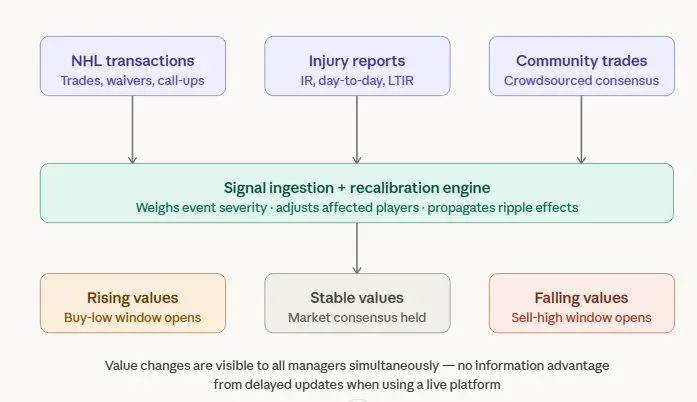
Real-time player value updates
Real-time value updates address this by constantly aligning calculator scores with current events throughout the NHL. Community-centered platforms such as Keep Trade Cut take an additional step: each trade provided by managers from numerous leagues contributes to a crowdsourced consensus model that constantly adjusts player values according to genuine market activity.
League Format Customization
Each dynasty league has a unique scoring system, and a player’s worth can vary greatly based on whether your league gives points, monitors categories, utilizes a keeper system, or implements specific roster regulations.
A trade calculator that disregards league format provides generic market consensus values—helpful as a baseline, yet possibly deceptive for your particular league situation.
Rookie and prospect evaluation
Rookies and prospects are the key to winning or losing in dynasty leagues. Recognizing a star before his breakout — and securing him at prospect rates before his value skyrockets — is the key ability of top dynasty managers.
It’s also the point where general trade calculators often struggle, as conventional valuation models are tailored for established. NHL contributors, not for players whose peak performance is still to come. Assessing prospects necessitates a distinctly different approach compared to valuing established players.
The critical factors include not just current output, but also growth path, readiness for the NHL, assurance of role, and confidence in potential.
Trade fairness analysis
Trade fairness assessment is the concluding element that brings everything together — the point where all separate evaluations, format modifications, and prospect ratings are merged into one decision on whether a particular deal is reasonable.
A thorough fairness assessment extends beyond merely evaluating overall value scores. It analyzes the agreement through five aspects: numerical equilibrium, asset quality spread, timeline congruence, positional necessity, and market timing.
The basis is numerical equilibrium. The calculator determines the overall adjusted value of each asset on each side and generates a percentage difference. Agreements within 5% are viewed as reasonable.
Agreements ranging from 5–15% benefit one party, yet can be justified depending on the circumstances. Agreements exceeding 15% are marked as distinctly unequal and should prompt a renegotiation or a firm rejection.
Benefits of Using a dynasty dominator trade calculator
Avoid unfair trades
A dynasty trade calculator serves as your personal protection against unbalanced trades, providing you with an immediate numerical evaluation before accepting any proposal. Rather than depending on intuition or brand familiarity, you receive a straightforward value comparison that shows precisely when an adversary aims to underpay — and what an equitable counter-offer resembles.
Build a long-term winning team
Dynasty success is established over years, not mere weeks, and each trade either bolsters or subtly weakens your franchise’s future. A calculator preserves your long-term asset pool by revealing the actual expense of win-now strategies, assisting you in balancing short-term success with the young talent and draft selections that will support your team across several championship opportunities.
Improve decision-making confidence
Entering a trade negotiation armed with data significantly alters your approach. Rather than doubting your decisions after each trade, you take actions you can support with data — and when league members challenge you, you possess the statistics to stand firm or adapt thoughtfully instead of giving in to social pressure.
Save time on manual analysis
A trade calculator condenses everything into seconds, allowing you to concentrate on strategy and roster management instead of being overwhelmed with spreadsheets and scouting reports all week
Common Mistakes to Avoid in Hockey Trades
Key differences explained
In dynasty, they are on different levels — the veteran has two or three seasons remaining while the young player has ten years of top-level hockey ahead, making age the most influential factor in how dynasty calculators evaluate each player on your roster.
Long-term vs short-term player value
Dynasty management resembles operating an actual NHL franchise — you cultivate prospects, oversee a rebuild, safeguard draft assets, and consider multi-year periods instead of just weekly games.
Success is not about managers who pursue fleeting trends, but rather those who grasp roster construction phases, properly assess long-term assets, and utilize all available resources to make choices that enhance their franchise in three to five years, rather than just this week.
How to Use the Dynasty Hockey Trade Calculator (Step-by-Step)
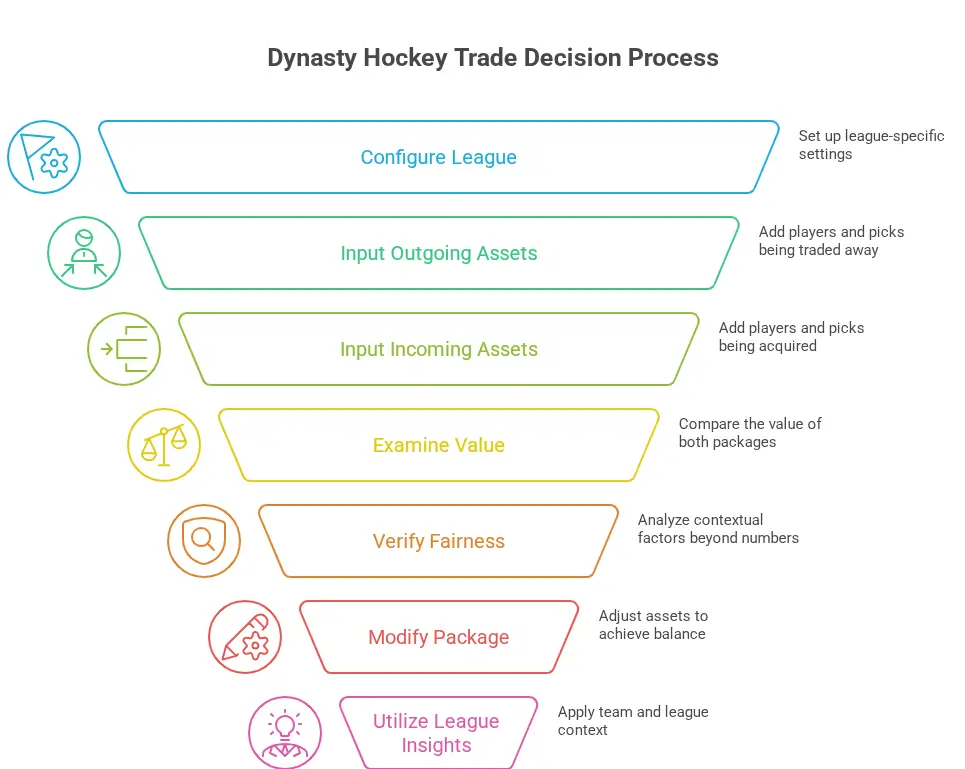
Step 1= Enter player names
Before examining any trade, you set up the calculator to align with your unique league format — scoring type (points or categories), roster dimensions, keeper regulations, and any personalized stat priorities your league employs.
Bypassing this step implies that you’re evaluating your players based on standard market values instead of the true competitive setting your roster is part of, potentially causing significant miscalculations in a trade.
Step 2 = Add draft picks (if applicable)
After entering all assets and settings, the calculator quickly generates a side-by-side value comparison — total score for each package, a percentage difference, and a straightforward fairness assessment indicating if the deal is equitable, somewhat uneven, or definitively overpriced.
This one screen provides you with more useful information than countless hours of manual research could yield.
Step 3 = Analyze trade results
Should the analysis show an imbalance, the calculator transforms into a negotiation instrument — allowing you to exchange players, enhance or reduce selections, and test various package combinations instantly until both parties arrive at a mutually agreeable value.
This repetitive process transforms what once was a guessing game into a specific, data-driven dialogue in which you clearly understand what is necessary to ensure any deal is equitable before presenting it to your leaguemate
Manual vs Automated Trade Evaluation
Advantages and Disadvantages of Manual Assessment
Manual analysis provides complete authority over your assessment process — you can incorporate personal league insights, particular matchup histories, and contextual specifics that no algorithm can ever understand, making it truly beneficial for managers who dedicate the effort.
The drawback is that it is sluggish, erratic, and highly prone to cognitive biases — you will unintentionally overrate players from your own team, underestimate unknown players, and alter your evaluations on the same trade based on your feelings that day.
Benefits of Utilizing Automated Tools
A dynasty trade calculator removes bias, condenses extensive research into mere seconds, and uses the same reliable method for every player and selection, regardless of popularity or current trends.
It continually integrates community trading information and real-time NHL events that no single manager could realistically manage on their own, providing you with an always updated market consensus that shows what thousands of engaged dynasty managers collectively value each asset at this moment.
Common Mistakes to Avoid in Hockey Trades
- Overvaluing big names
- Ignoring future potential
- Not considering league format
- Trading based on emotions
Tips to Win More Trades in Dynasty Hockey
- Buy low, sell high strategy
- Target young breakout players
- Understand trade timing
- Balance present and future value
Best Players to Target in Dynasty Hockey Leagues
- Rising stars
- Underrated players
- Long-term prospects
When Should You Use a Trade Calculator?
- Before accepting trades
- During trade negotiations
- While rebuilding your team
Limitations of dynasty startup trade calculator
- Not 100% accurate
- Cannot predict future perfectly
- Requires user judgment